
 NOTE TRAINER
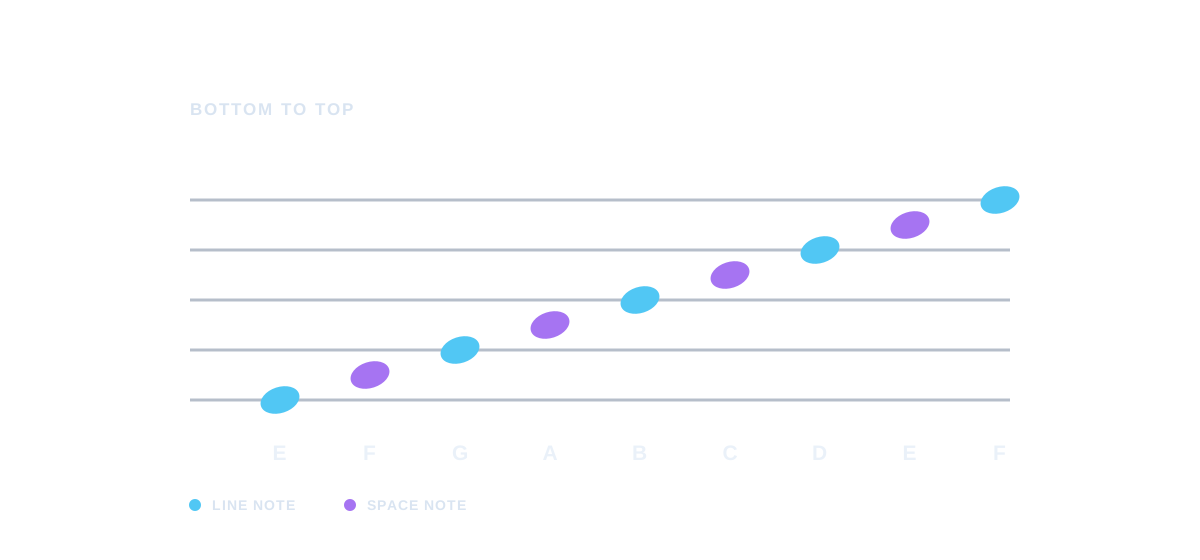
In treble clef, the five staff lines from bottom to top are E, G, B, D and F. The spaces from bottom to top are F, A, C and E. Read one position at a time upwards, alternating between line and space. Once you know those nine positions, nearby ledger lines follow the same musical alphabet.
What the treble clef tells you
A clef gives the staff its note names. The treble clef symbol curls around the second line from the bottom, marking that line as G. From there, name the remaining lines and spaces in alphabetical order. After G, return to A.
The treble clef is used for many higher pitched parts and is common in piano music, violin, flute, guitar and singing. Instruments vary in range and some transpose written notes, but the staff positions themselves still follow the clef’s note pattern.
Treble clef lines from bottom to top
- Bottom line: E
- Second line: G
- Middle line: B
- Fourth line: D
- Top line: F
A common memory phrase is “Every Good Boy Deserves Football”. Use it if it helps, but also learn the actual sequence E, G, B, D, F. Knowing the sequence lets you work out a note even if the mnemonic slips your mind.
Treble clef spaces from bottom to top
- First space: F
- Second space: A
- Third space: C
- Top space: E
The four space notes spell FACE from bottom to top. This is a handy check, but remember that the letters continue above and below the staff too.
Work through a note step by step
Suppose a note sits in the second space from the bottom. The bottom line is E, the space above is F, the next line is G, and the next space is A. So the note is A. If a note is on the line above that, it is B.
This bottom up method is dependable for notes anywhere on the staff. With practice, familiar notes become quicker to recognise directly, while counting remains a useful way to check a less familiar position.
Read notes above and below the staff
When a melody goes beyond the five lines, ledger lines extend the staff. Middle C is the first important ledger line below the treble staff. It is one step below the bottom line E, with D in the space between E and C. Above the staff, continue upwards from the top line F to G in the space, A on the first ledger line, and B in the next space.
Ledger lines are not a new system. They continue the same alternating pattern of line, space, line, space. Read them with the treble clef just as you read notes inside the staff.
Remember that key signatures change the pitch
The staff position gives you a letter name, but the key signature may alter its pitch. A sharp raises a note by a semitone, a flat lowers it by a semitone, and a natural sign cancels an earlier alteration where it applies. Check the key signature near the clef before naming or playing a note.
For example, if the key signature sharpens F, every F in the passage is played as F sharp unless a natural sign changes it for that bar. The written note remains on an F position; the accidental tells you which pitch to use.
A quick treble clef practice exercise
- Write the five line notes from bottom to top: E, G, B, D, F.
- Write the four spaces between them: F, A, C, E.
- Choose a note at random on a blank treble staff and name it before checking.
- Add middle C below the staff, then add D in the space above it.
- Repeat with notes in a different order and include one sharp or flat.
Keep the exercise short. Five to ten notes is enough for one round. Correct the notes you miss, shuffle the order, and try again later without looking at your earlier answers.
Common treble clef confusions
- Reading from the top down by habit. Begin at the bottom line E, then move up one letter at each staff position.
- Mixing up lines and spaces. A line note touches a staff line; a space note sits between two lines.
- Forgetting that the alphabet cycles. After G comes A again, at the next octave.
- Leaving out accidentals. Read the position and the key signature together.
- Depending only on a phrase. Mnemonics are prompts, not a substitute for recognising note positions.
Build confidence with short practice
Read a short line slowly, name each pitch, then clap or count its rhythm. If identifying notes is the part that takes longest, Note Trainer offers interactive exercises for note recognition and treble clef practice. You can also revisit the beginner’s guide to reading music notes for the wider picture, or see how to practise sight reading.