
 NOTE TRAINER
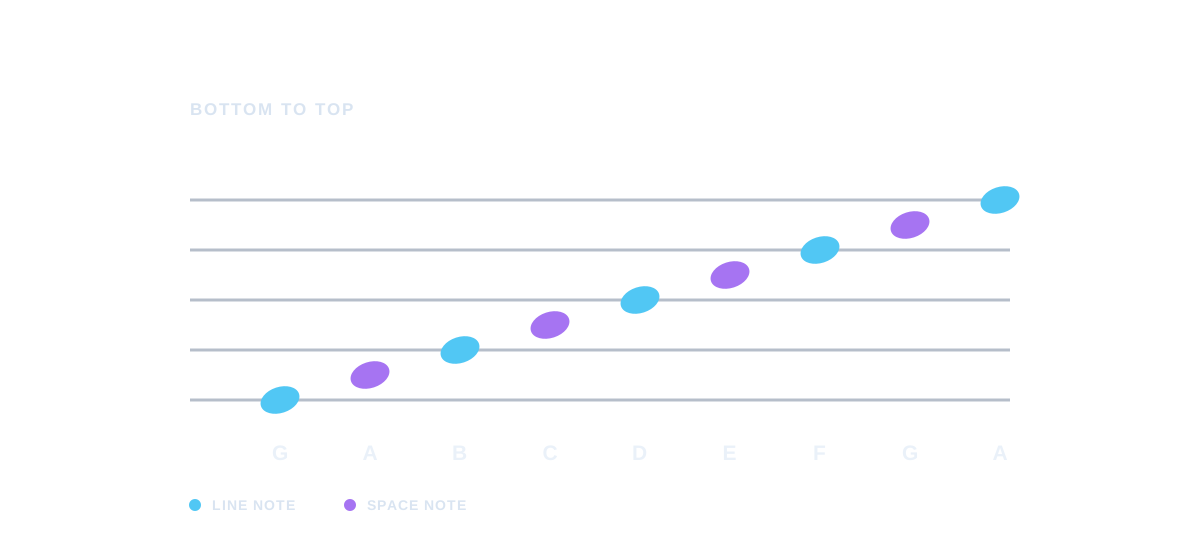
In bass clef, the five staff lines from bottom to top are G, B, D, F and A. The spaces from bottom to top are A, C, E and G. The two dots in the clef sit around the F line, which is the fourth line from the bottom. Start with that pattern, then follow the musical alphabet into ledger lines when notes fall outside the staff.
Why music uses bass clef
Bass clef is used for many lower pitched parts. You will see it in cello, bassoon, trombone, bass guitar notation and the lower staff of piano music. It lets lower notes sit on the staff instead of requiring many ledger lines.
The clef symbol is sometimes called the F clef because its two dots surround the line for F. In bass clef that F is F3 in scientific pitch notation. The clef anchors all the other staff positions around it.
Bass clef lines from bottom to top
- Bottom line: G
- Second line: B
- Middle line: D
- Fourth line: F
- Top line: A
A common phrase for the lines is “Good Boys Deserve Football Always”. You can use it as a memory aid, but say the note names too: G, B, D, F, A.
Bass clef spaces from bottom to top
- First space: A
- Second space: C
- Third space: E
- Top space: G
The spaces spell A, C, E, G. One way to remember them is “All Cows Eat Grass”. Move through the staff one position at a time and the line and space notes alternate.
Find middle C above the bass staff
On a piano grand staff, middle C is written on a ledger line between the treble and bass staves. Relative to the bass staff, middle C is above the top line A. B sits in the space immediately above A, and C is on the next ledger line.
This is the same middle C used as a landmark in treble clef. In treble clef it is below the staff; in bass clef it is above. If you are learning both piano staves, practise moving from middle C into each staff separately so the different clef patterns stay clear.
For the wider overview, start with how to read music notes. For the upper piano staff, see the treble clef guide.
Follow the alphabet through ledger lines
Ledger lines extend the five line staff above or below it. They do not change the note naming system. Above the bass staff, continue from the top line A to B in the space, C on the next ledger line and D in the next space. Below the staff, move down from the bottom line G to F in the space, E on the first ledger line and D in the next space.
When a note looks unfamiliar, find the nearest line or space you know and count each step. Keep track of whether the note is on a line or in a space. With practice, notes in your regular range become easier to recognise without counting.
Check the key signature and accidentals
The bass clef tells you the letter name at each staff position. The key signature, written just after the clef, tells you which letters are sharpened or flattened throughout the piece. A sharp raises the pitch by a semitone, a flat lowers it by a semitone, and a natural sign cancels an alteration where it applies.
For instance, if the key signature includes B flat, a note on a B position is played as B flat unless a natural sign changes it for that bar. Its position and letter are still B.
A short bass clef exercise
- Write the line notes from bottom to top: G, B, D, F, A.
- Write the spaces between them: A, C, E, G.
- Point to the F line, then find the B line and D middle line.
- Add middle C on the ledger line above the staff.
- Name five notes from a simple bass part, then check the key signature and rhythm.
To make the notes easier to remember, shuffle the order each time. You can also alternate between naming a staff note and finding the matching piano key. If piano note positions are your main challenge, try this guide to memorising piano notes.
Common bass clef mistakes
- Using treble clef note names by mistake. Read the clef symbol before naming the staff position.
- Placing F on the wrong line. The bass clef dots surround the fourth line from the bottom, F.
- Forgetting the line and space order. The sequence alternates as you move through the alphabet.
- Stopping at the five lines. Ledger lines continue the same pattern above and below.
- Skipping the key signature. Check whether a note is sharp or flat before playing it.
Practise in context
Choose a short bass line. First name the notes without playing, then clap its rhythm, and finally play or sing it slowly while keeping a steady pulse. For extra note recognition practice, Note Trainer includes bass clef exercises. Return to beginner sight reading practice once the note names feel more familiar.